

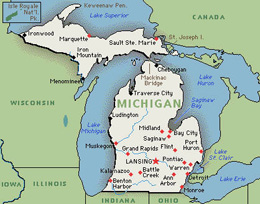
Michigan has lots of sunshine and laws that are favorable for solar power and renewable energy.
In addition, the Federal Government offers a 30% tax credit for the whole installed cost of your system That's a huge benefit available to you no matter where you live in the US! Talk to a local installer about the incentives available in your area.

Michigan has strong RPS (Renewable Portfolio Standards). This is a regulation that requires utilities to increase their production of energy from renewable energy sources, such as wind, solar, biomass, and geothermal by a certain date. Utilities must meet the standards by either producing their own renewable energy or by purchasing it from customers. They must pay high fees if the standards are not met. Rather than paying high fees, utilities in strong RPS state offer solar incentives to homeowners. Michigan's RPS is voluntary at 40% by 2025.
Solar carve outs require a certain percentage of the Renewable Portfolio Standards to be met with solar energy. Michigan has not solar carve out.
Michigan's electric rates rank 12th out of the fifty states. A state's electric rates are one of the key factors in predicting whether an investment in solar panels makes sense. The reason for this is simple: solar power is in direct contention with electric rates. Low electric rates make it hard for you to achieve significant payback from your solar power investment. Higher electric rates make an investment in solar energy much more feasible. Michigan's high electric rates make investing in solar power more attractive.
Michigan offers very strong net metering laws. Net metering is a system in which solar panels or other renewable energy generators are connected to a public-utility power grid and surplus power is transferred into the grid, allowing customers to offset the cost of power drawn from the utility. When you generate electricity from your solar array for your home or business, it reduces the amount of energy you purchase from your electric utility. it also lowers your monthly electricity bills. If your system produces more energy than you need, the excess power is sold back to the grid. That amount of energy is deducted from your monthly bill or credited toward a future bill.
Interconnection standards are requirements for connecting solar and other electrical generation systems to the grid. These rules apply to both electricity customers and utilities. Michigan has strong statewide interconnection standards which makes the interconnection process less complex and expensive. This can be a definite benefit when trying to bring a solar energy system online and makes it easier for a solar power system to make financial sense.
Solar power rebates are incentives federal or state governments offer to reduce the cost of going solar. Michigan does not offer state energy rebates. You can get a lump sum payment or your installer will take the amount off the final installed price. Rebates require paperwork to be filed. Our installers will handle the paperwork. Talk with an expert solar installer to see how to qualify. And don't forget, the Federal rebate for installed solar systems is 30%.
Michigan does not offer state income tax credits. As a credit, you take the amount directly off your tax payment, rather than as a deduction from your taxable income. You can claim the credit for your primary residence, vacation home, and for either an existing structure or new construction.
Michigan offers Solar Power Performance Payments, also know as production incentives. Solar Power Performance Payments provide small cash payments based on the number of kilowatt-hours (kWh) or BTUs generated by a renewable energy system. Payments based on a system's actual performance are much more effective than payments based on a system's rated capacity. Electricity produced is credited as Solar Renewable Energy Credits (SRECs). SRECs are a great way to help your Solar PV system pay for itself.
Michigan does not offer property tax exemptions for installed solar systems. Property tax exemptions allow businesses and homeowners to exclude the added value of a system from the valuation of their property for taxation purposes. A Solar PV system can increase the value of your home by a multiple of 20 times your annual electricity savings (a 5kW system increases the value of your home close to $17,000). A property tax exemption makes it more economically feasible for a taxpayer to install a solar system on a residential or commercial property.
Michigan does not offer sales tax exemptions. A sales tax exemption means that homeowners and businesses would not have to pay any state sales tax on their solar panel system. Combine the falling costs of solar equipment and installation, higher electric rates, and the 30% Federal tax rebate and you have good reasons to go solar in Michigan!
877-331-1235 | © Copyright DASolar.com.