
home wind power - free wind evaluation

Home wind power - free evaluation

Home wind power is growing rapidly across the US as one of the most cost efficient forms of energy for the home.  Installations of home wind power systems have skyrocketed in the past three years as wind turbine technology has improved, incentives have increased and oil and electricity prices have fluctuated.  No longer confined to remote locations or wind farms, home wind power has sprouted up in cities and suburbs with with new and innovative wind generator designs like the vertically oriented Helix wind turbine (see video).  Home wind power has come of age as a key component of the trend towards renewable energy sources like solar energy, biomass, hydroelectric, tidal and geothermal.

Simply complete the form below and a Wind Power Pro will call to begin your wind evaluation...

Free wind power evaluation

Required Fields required are marked with *.
Contact Information
*Please Choose Type:
*Address Line 1:
Address Line 2:
*City:
*State/Province:
*Zip Code:
*Type of Project:
First Name:*
Last Name:*
Email:*
Company:
*Phone:
Mobile Phone:
Contact time?
*Project Description: (please be specific!)

What are the benefits of home wind power?

Home wind energy systems provide a cushion against electricity price increases. Home wind energy systems also reduce U.S. dependence on fossil fuels, and they don’t emit greenhouse gases. If you are building a home in a remote location, a small wind energy system can help you avoid the high costs of extending utility power lines to your site. Home wind energy systems require an initial up-front investment, but are very competitive with conventional energy sources when you account for a lifetime of reduced utility costs (or elimination of those costs entirely).

Home wind power equipment

All wind systems consist of a wind turbine, a tower, wiring, and the “balance of system” components: controllers, inverters, and/or batteries. These components are often packaged together in home wind power kits for ready installation.  Hybrid systems use additional equipment, like photovoltaic solar panels and diesel generators to ensure electricity is available at all times.

Is wind power practical for me?

Small wind energy systems can be used in connection with an electricity transmission and distribution system (called grid-connected or net-metering systems), or in stand-alone applications that are not connected to the utility grid.

How does a home wind power turbine work?

Home wind turbines consist of a rotor, a generator mounted on a frame, and a tail. Through the spinning blades, the rotor captures the kinetic energy of the wind and converts it into rotary motion to drive the generator. Rotors can have two or three blades. The best indication of how much energy a turbine will produce is the diameter of the rotor, which determines its “swept area,” or the quantity of wind intercepted by the turbine. The frame is the strong central axis bar that the rotor, generator and tail are attached to. The tail keeps the turbine facing into the wind.

A 1.5-kilowatt (kW) wind turbine will meet the needs of a home requiring 300 kilowatt-hours per month, for allocation with a 6.26-meters-per-second (14-mile-per-hour) annual average wind speed. Most turbines have automatic speed-governing systems to keep the rotor from spinning out of control in very high winds.

What about a tower?  Do I need one?

Because wind speeds increase with height in flat terrain, the turbine is mounted on a tower. Generally speaking, the higher the tower, the more power the wind system can produce. The tower also raises the turbine above the air turbulence that can exist close to the ground. A wind turbine should be installed on a tower with the bottom of the rotor blades at least 9 meters (30 feet) above any obstacle that is within 90 meters (300 feet) of the tower.

There are two basic types of towers: self-supporting (free standing) and guyed. Most home wind power systems use a guyed tower. Guyed-lattice towers are the least expensive option. They consist of a simple, inexpensive framework of metal strips supported by guy cables and earth anchors.

Conditions needed for stand-alone systems: You live in an area with average annual wind speeds of at least 9 miles per hour; a grid connection is not available or can only be made through an expensive extension. The cost of running a power line to a remote site to connect with the utility grid can be prohibitive, ranging from $15,000 to more than $50,000 per mile, depending on terrain; you have an interest in becoming energy-independent; and you would like to reduce the environmental impact of electricity production.

Conditions needed for grid-connected systems: You live in an area with average annual wind speeds of at least 10 miles per hour; utility-supplied electricity is expensive in your area (about 10 to 15 cents per kilowatt-hour); the utility’s requirements for connecting your system to its grid are not prohibitively expensive; local building codes allow you to legally erect a wind turbine on your property; and you are comfortable with long-term investments.

Tags:  home wind power, home wind power kits, wind power for home, wind power home, home wind power generators

Source: US Department of Energy - Wind Energy


Talk with a wind pro
Get a free home wind power evaluation to find out if a residential wind turbine will work for you
Join our mailing list

Proud Member of:
Solar Energy Industries Association

American Solar Energy Society

American Council on Renewable Energy

American Wind Energy Association


Wind Power detailed history
Wind turbine installation steps

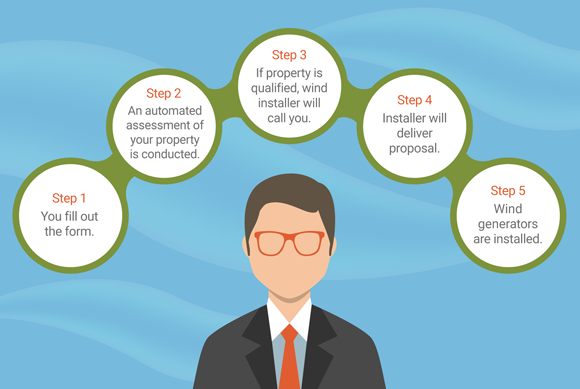
Home Wind Power Installation - The Process

Step 1.  Fill out the residential wind power installation form to give us basic information on your home, the proposed location for the turbine, and your contact information.

Wind Turbine Installation - Information gathering

Step 2.  A wind installer will call to ask further questions and arrange a visit to your home.

Step 3.  On-site visit to speak with the homeowner (see video), assess the location of the wind turbine.  Take wind measurements and answer specific questions about the wind power installation.

Step 4.  Wind installer will deliver detailed installation proposal.  Proposal includes all applicable rebates from state and federal energy tax credits.  Contracts signed.

Wind Generator Installation - Installation work begins

Step 5.  A typical residential wind power installation takes 1-2 days after the wind generator and equipment arrive. Home wind turbine installation will usually involve 2-3 installers working together to complete the job.  For some insight into the specifics of the installation process and wind turbine components, please visit our DIY Solar Network to view a series of wind turbine installation videos.

Ready to take the next step?  Fill out our wind turbine installation form.  We'll get right back to you! 

Cheers to you for harnessing the wind! Thank you for keeping our wind contractors working...